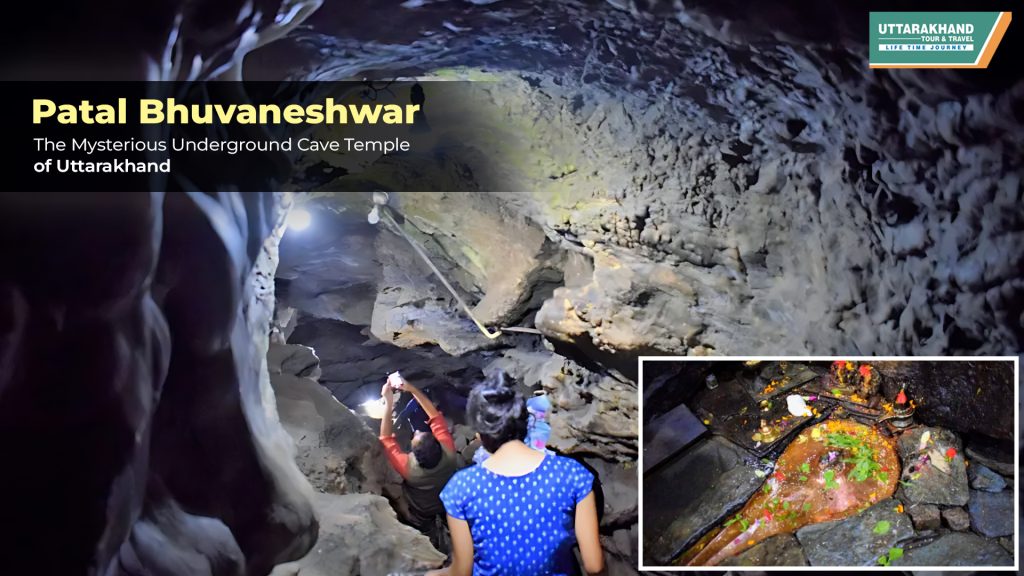
Situated in the Bhuvaneshwar village of the state of Uttarakhand, Patal Bhuvaneshwar is a 160-meter-long limestone cave, 90 feet deep, at a height of 1350 meters above sea level. Once inside the cave, you can witness the formation of the entire 33 Koti Devi Devta, including Shiva Parwati Parivar, Shesh Naag, Char Dham, Kal Bhairav, etc.
It is said that Patal Bhuvaneshwar was discovered by the renowned sage Adi Shankaracharya and now falls under the jurisdiction of the Archaeological Survey of India. Symbolized by mystery and mythology, Patal Bhuvaneshwar is a hidden pilgrimage center located near Gangolihat (13 km), the renowned Shaktipeeth of Uttarakhand.
There is an account of the existence of Patal Bhuvaneshwar in the Manas Khand of the Skanda Purana. It is believed that within the Patal Bhuvaneshwar cave, there are four doors, namely Randwar, Paapdwar, Dharamdwar, and Mokshadwar. The Paapdwar was closed after the death of Ravana, and the Randwar was closed after the war of Mahabharat. Currently, only two doors are open.
Visiting Patal Bhuvaneshwar is a thrilling experience for a devoteee as well as an adventure enthusiast. It is believed that by visiting the Patal Bhuvaneshwar Cave Temple, a person has visited the Char Dham of Uttarakhand. It is believed that the Patal Bhuvaneshwar cave is connected to Mount Kailash via an underground tunnel. The entrance of the Patal Bhuvaneshwar Temple is a bit challenging, but after entering the temple, the surroundings are quite pleasant and provide a sense of serenity.
A Sacred Cave Beneath the Earth
The name “Patal Bhuvaneshwar” itself is significant. “Patal” refers to the underworld. “Bhuvaneshwar” refers to Lord Shiva as the emperor of the universe. As the name suggests, this temple is situated 90 feet below ground level and extends over an area of 160 meters in length.
One must descend a narrow, steep entrance, at times holding chains of iron for support. The experience of going inside is thrilling and spiritual, as the cave slowly opens its hidden treasures.
Natural Formations That Tell Divine Stories
What makes this cave special are the natural limestone formations. Over time, water dripping from the cave walls has formed beautiful stalactites and stalagmites. These are not random formations but are said to resemble various Hindu gods and mythological symbols.
Inside the cave, devotees claim to witness shapes resembling:
- Lord Shiva’s lingam
- Sheshnag (the cosmic serpent)
- Lord Ganesha
- Goddess Kali
- The Pandavas from the Mahabharata
These naturally formed structures give the cave an almost mystical aura, as if nature itself has sculpted a divine gallery.
Mythological Significance and Legends
The cave temple has a strong link to Hindu mythology and is mentioned in Hindu scriptures called the Skanda Purana. According to mythology, King Rituparna of the Solar Dynasty first discovered this cave temple in the Treta Yuga.
One of the most intriguing stories is about how the king was led into the cave by a mystical deer. Once inside, he met Sheshnag, who took him through the cave and showed him that there were 33 “koti” (types) of gods and goddesses inside.
The other belief is that the cave is spiritually connected to Mount Kailash, which is the divine abode of Lord Shiva. It is believed that some hidden passages inside the cave lead to the holy mountain, though the passages are no longer accessible at present.
The cave was rediscovered and popularized by Adi Shankaracharya in the Kali Yuga, making it an important site for pilgrims.
A Place of Mystery and Spiritual Energy
Patal Bhuvaneshwar has also been described as one of the most mysterious places in India. According to local legends, the secrets of the universe and doomsday are hidden inside the cave.
Devotees believe that:
- All 33 types of deities reside within the cave
- The cave represents a miniature version of the universe
- Visiting this temple is equivalent to visiting multiple sacred sites
The dim lighting, echoing chants, and narrow pathways all add to the mystical experience and create the illusion that one has entered another world.
How to Reach Patal Bhuvaneshwar
Patal Bhuvaneshwar is located in the Pithoragarh district of Uttarakhand. Here’s how you can reach:
- By Air: Nearest airport is Pantnagar Airport (~240 km)
- By Train: Kathgodam Railway Station (~210 km)
- By Road: Well-connected via Almora, Pithoragarh, and Gangolihat
From Almora, the cave is about 90 km and can be reached by taxi or local transport.
The Spiritual Experience Inside
Entering this cave is not only a physical journey but also a spiritual one. While you descend further and further into this cave, you see that the world outside is forgotten and replaced by silence, coolness, and wonder.
Priests and guides within this cave describe to you the importance and relevance of each and every formation, linking them to stories from the Ramayana and Mahabharata. Rituals such as havan are performed in a serene and sacred environment.
It is a powerful and calming feeling all at once, a combination that is not often found and is sure to leave a lasting impression on all visitors.
Location and Accessibility
The temple is located about 14 km from Gangolihat in the Pithoragarh district of Uttarakhand.
To reach the cave:
- The nearest railway station is Kathgodam
- The nearest airport is Pantnagar
- From there, visitors can travel by road to Gangolihat and then to the temple
Though the journey requires effort, the destination is well worth it for those seeking spirituality and adventure.
Best Time to Visit
Patal Bhuvaneshwar Temple timings are between 8 a.m. and 6 p.m. during the summer season, and between 9 a.m. and 5 p.m. during the winter season. People are allowed in batches of 20-30 people at a time to enter the cave. The best time to visit the Patal Bhuvaneshwar temple is between April and June (summer season) and October and February (winter season). It is not recommended to visit the Patal Bhuvaneshwar cave during the monsoon season.
Why You Should Visit Patal Bhuvaneshwar
Patal Bhuvaneshwar is not just a tourist attraction — it is an experience that combines:
- Spiritual depth
- Natural beauty
- Mythological richness
- Adventure
Whether you are a devotee, a traveler, or someone curious about India’s ancient mysteries, this cave temple offers something truly unique.
FAQ’s
1. What is Patal Bhuvaneshwar famous for?
Patal Bhuvaneshwar is famous for its underground limestone cave temple filled with natural formations believed to resemble Hindu gods and mythological symbols.
2. Where is Patal Bhuvaneshwar located?
It is located in the Pithoragarh district of Uttarakhand, near Gangolihat in the Kumaon region.
3. How deep is the Patal Bhuvaneshwar cave?
The cave temple is approximately 90 feet deep and stretches around 160 meters inside the earth.
4. What is the mythological significance of Patal Bhuvaneshwar?
According to Hindu mythology, the cave houses 33 crore deities and is linked to stories from the Ramayana and Mahabharata.
5. Is Patal Bhuvaneshwar safe to visit?
Yes, it is safe, but visitors must be cautious while descending through the narrow and steep cave entrance using chains.
6. What is the best time to visit Patal Bhuvaneshwar?
The best time to visit is between March–June and September–November when the weather is pleasant.
7. How can I reach Patal Bhuvaneshwar?
You can reach via Kathgodam railway station or Pantnagar airport, followed by a road journey to Gangolihat.
8. Are there any entry fees for the cave temple?
There is usually a small entry or maintenance fee, and guides may charge separately for explaining the cave’s significance.
9. Can elderly people visit Patal Bhuvaneshwar cave?
Elderly visitors can visit, but it may be physically challenging due to steep and narrow passages.
10. Why is Patal Bhuvaneshwar called a mysterious temple?
It is considered mysterious due to its underground structure, naturally formed divine shapes, and ancient legends about hidden paths and cosmic connections.
Conclusion
The Patal Bhuvaneshwar Cave Temple serves as a wonderful example of the marriage between the forces of nature and faith. While buried in the depths of the earth, this temple encourages visitors to not only explore the depths of the cave but also the depths of faith and spirituality.In the midst of the modern world, temples like the Patal Bhuvaneshwar serve as reminders of the eternal enigmas that continue to capture the imagination of the world. A visit to this temple is not just a visit to a cave; it is a visit to the spiritual legacy of the ancient Indians.