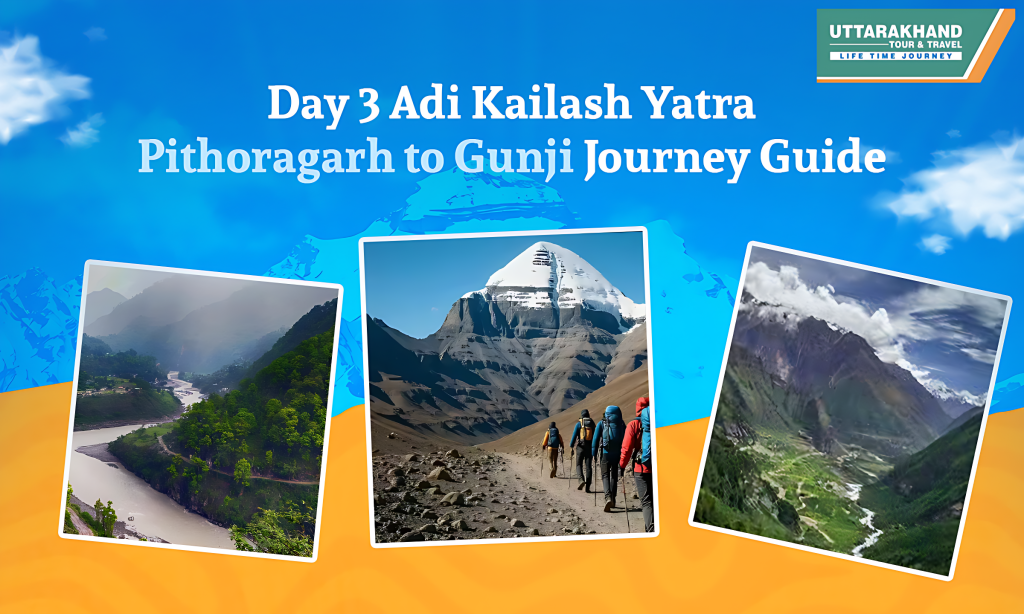
Day 3 of the Adi Kailash Yatra marks a powerful shift in the journey—both organically and spiritually. As pilgrims travel from Pithoragarh to Dharchula and onward to Gunji, they officially enter the inner Himalayan section where nature becomes wilder, roads narrower, and spiritual energy stronger. This day is not just about covering distance; it is about crossing thresholds into a sacred land guarded by rivers, forests, and ancient silence.
Pithoragarh to Dharchula – Gateway to the Inner Himalayas
The journey begins early from Pithoragarh, as the group drives to Dharchula, a small but significant town located near the Indo-Nepal border. Dharchula lies along the banks of the Kali River, which flows fiercely through deep Himalayan valleys. This river will now accompany pilgrims for much of the yatra, acting as both a geographical guide and a spiritual presence.
Dharchula is also where Inner Line Permit formalities are confirmed, as the route ahead lies close to the Indo-Tibetan border. Once formalities are complete, pilgrims truly feel that they are stepping into a delimited, sacred, and ancient Himalayan zone.
Crossing the Dhauli Ganga Bridge – A Sacred Confluence
Soon after Dharchula, pilgrims cross a bridge over the thriving Dhauli Ganga River. Here, one witnesses a breathtaking and spiritually significant sight—the confluence of the Kali and Dhauli rivers. The merging waters symbolise unity, balance, and the meeting of energies, often prompting pilgrims of the sacred sangams found across India.
Standing near this confluence, with icy river currents echoing through the mountains, many pilgrims pause instinctively, contributing silent prayers and gratitude before moving deeper into the yatra.
Journey Along the Kali River Through Dense Forests
From here, the road runs parallel to the Kali River, winding through dense Himalayan forests. Towering faces, thick pine and deodar trees, and dramatic mountain shadows create an atmosphere of awe. The road may be challenging at times, but the scenery compensates abundantly.
Along this stretch, pilgrims witness numerous natural springs and cascading waterfalls flowing directly into the river. These untouched water sources are considered pure and life-giving, adding to the sacred feel of the route. The sound of flowing water, birds, and mountain winds replaces all traces of urban noise.
Chhialekh – Meadows at the Edge of the Sky
As the vehicle climbs higher, the landscape opens into the beautiful high-altitude pasture of Chhialekh. This region marks the entrance into the revered Byans Valley. Spread across wide Himalayan meadows, Chhialekh is carpeted with alpine grasses and seasonal wildflowers, contribution a rare moment of openness amidst rugged terrain.
Pilgrims often feel a sudden sense of lightness here—the air is cooler, the sky feels closer, and the surroundings seem untouched by time. Chhialekh also serves as a natural acclimatisation zone, allowing the body to adjust gradually to higher altitudes.
Garbhiang Village – Echoes of a Silent Past
Continuing ahead, the route passes through Garbhiang village, a once-inhabited settlement now largely deserted due to geopolitical and geological reasons. Though silent today, Garbhiang holds deep historical and emotional significance.
Near this village, pilgrims witness another remarkable confluence—where the Kali River meets the Tinkar River, which flows in from Nepal. This meeting of rivers near an abandoned village creates a forcefully beautiful scene, reminding travellers of nature’s permanence and human impermanence.
The silence here is profound. Many pilgrims describe Garbhiang as a place that encourages introspection and humility.
Arrival at Gunji – A Sacred Himalayan Settlement
By evening, the group reaches Gunji, situated at an altitude of approximately 3,500 meters. Gunji is a small but vital village in the Byans region, helping as a base for pilgrims heading towards Adi Kailash and Om Parvat.
An overnight stay at Gunji allows pilgrims to rest, acclimatise, and absorb the spiritual heaven of the high Himalayas. As night falls, the sky fills with countless stars, and the silence of the mountains deepens the sense of devotion and surrender.
Final Words
The Adi Kailash Yatra 2026 is not just a trip — it is a journey inward. The itinerary ensures proper acclimatization, safety, and meaningful darshan while allowing enough time to absorb the spiritual atmosphere of the Himalayas.
Whether you seek Lord Shiva’s blessings, inner peace, or simply a break from worldly chaos, this pilgrimage offers a rare combination of adventure and devotion.
Call to Action:
📞 Call: +91 9634755026
🌐 Walk the sacred Byans Valley on Adi Kailash Yatra 2026 — book now at adikailashmansarovar.com
Get exclusive updates — follow us on Instagram